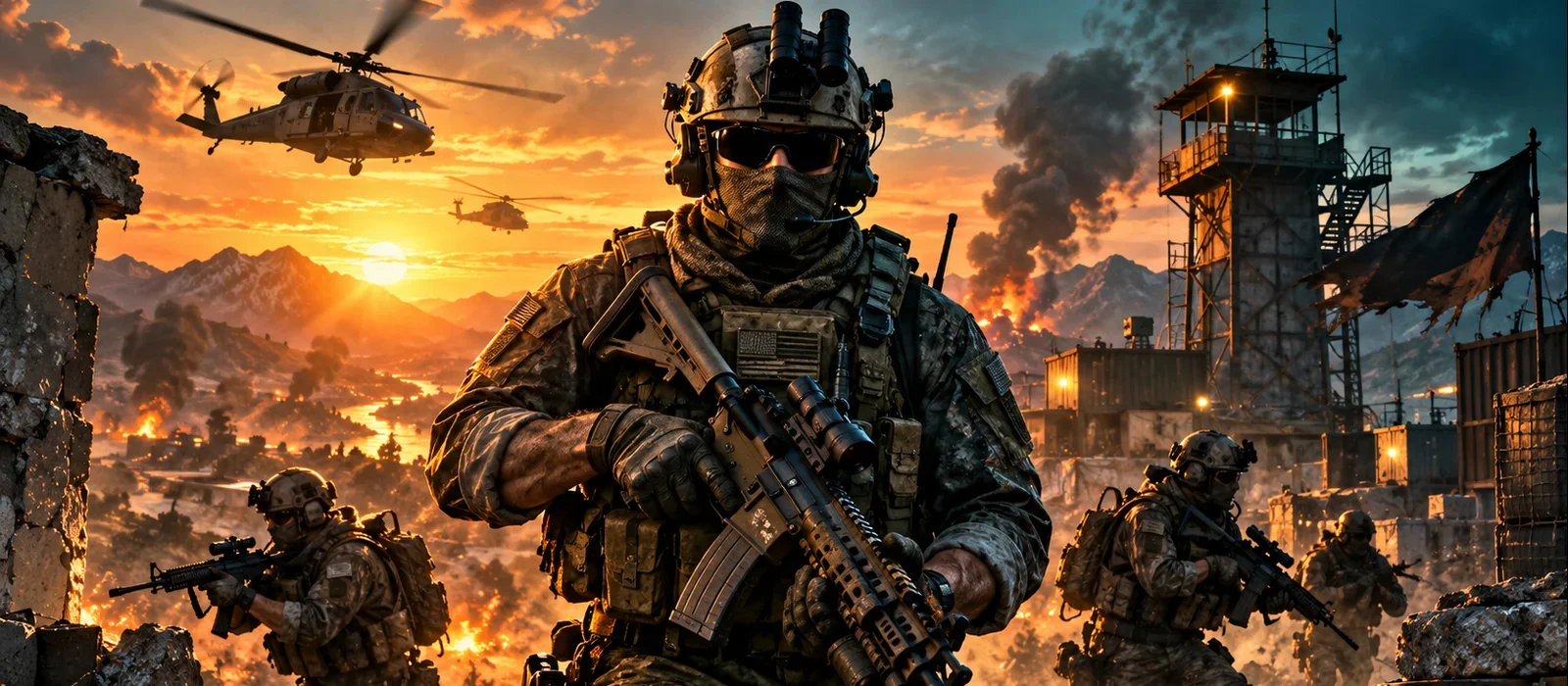
WARDOGS entered Steam Early Access on September 10, 2026, and developer BULKHEAD immediately gave players an unusual mix of mechanics: three teams fighting each other, the risk of losing all purchased gear on death, and plenty of chaos when those systems collide. In this guide, we'll break down what to buy, which weapons, ammo types, and equipment are worth the money, and which ones are better left alone.
The game's economy is straightforward: if you die, you lose everything you were carrying. Your cash carries over between matches, and you start with $10,000. That means choosing a weapon isn't just about raw power. An expensive gun you can't afford to lose regularly is often less useful than a cheaper option you're comfortable risking.
Meta-progression adds another layer. Weapons and equipment unlock as you level separate progression paths for Assault, Recon, Support, and Medic. There are also dedicated Driver and Pilot trees. The developers plan to reset parts of the economy and progression during seasonal cycles, so some of your available gear will need to be unlocked again over time.
How the Weapon Economy Works in WARDOGS

Before rushing to buy your first rifle, there's one important detail to understand: purchase price and unlock cost are two different things. For a weapon to appear in your equipment store, you often need both a certain progression level and a one-time unlock payment, which can reach $100,000–$200,000. After that, you still need to buy the weapon itself for each deployment, although the per-use price is much lower.
Base damage depends heavily on the ammunition type and caliber, but a weapon's overall effectiveness is also affected by muzzle velocity, fire rate, damage drop-off over distance, and other stats. A good rule for managing your money is to keep enough cash in reserve for two additional full loadouts. If you're using the budget setup described at the end of this guide, try to keep around $12,000–$16,000 in reserve. If your budget is too tight, buy a cheaper gun rather than cutting back on armor and medical supplies.
Best Weapons in WARDOGS
Now let's get to the guns themselves.
Assault Rifles
The starting rifles, Bushmaster M17S, A-91, and KH-2002, are very similar in terms of overall performance and use the same general weapon class. The differences aren't especially noticeable early on, so there's little reason to stick with them for long. They're useful mainly until you can afford something better.
T-21 ($600). This can be your first meaningful upgrade. For very little money by WARDOGS standards, you get full-auto fire and solid baseline performance comparable to much more expensive rifles. It's perfectly viable until you've built up enough cash to move on to something better.
AK74 ($1,600). It isn't the fastest-firing assault rifle in the game, but it's extremely forgiving. The recoil is predictable even without attachments, and the default sights are comfortable to use. That's why many players save for the AK74 first instead of spreading their money across multiple weapons.

Galil ($2,200). It deals more damage per shot than the AK74 and has a lower fire rate, making it noticeably easier to control at medium and long range. Many players consider the Galil one of the best balances between price, damage, and recoil at this stage of progression.
M4 ($2,800). A more controversial option. On paper, it's a versatile upgrade with a higher fire rate, but in practice many players find that it burns through ammunition faster than it converts that rate of fire into meaningful damage. Long bursts are also harder to control than with the Galil. If you're choosing between the M4 and Galil at a similar price point, the Galil is generally the safer option.
FAL ($6,500). The top-end choice in this branch. It offers high damage per shot, automatic and semi-automatic fire modes, and manageable recoil at medium range. The downside is obvious: losing one hurts. Still, if your bankroll is large enough to keep buying it consistently, the FAL is often the best all-purpose rifle available.
Submachine Guns
AMP-9 ($900). An early SMG with solid hip-fire performance and fast weapon handling, but its damage against armored targets drops off quickly with distance. Its headshot multiplier is also noticeably lower than that of assault rifles.
PP-19 Vityaz ($1,200). Not a particularly attractive purchase. Its available magazine options are awkward, with either a 10-round drum or a magazine that takes up two inventory slots. Recoil is also higher than comparable weapons, while damage remains similar to the AMP-9. It's usually better to skip it and save for another option.

Super-45 ($2,600). It unlocks fairly late in the Medic progression tree and isn't cheap, but it's one of the easiest weapons in the game to control vertically. At close range it can shred opponents, and with the right optic it's surprisingly effective at longer distances as well.
Machine Guns and Sniper Rifles
PKM ($4,500). Heavy and cumbersome, but once the bipod is deployed it turns into a proper defensive firing position. It's excellent for holding objectives or covering your team's retreat.
M249 SAW ($3,200). A cheaper alternative to the PKM with a similarly heavy loadout footprint. However, it doesn't avoid the usual drawbacks of an LMG: slow aim-down-sights speed and heavy reliance on the bipod remain.

Scout Rifle TD ($1,100). The starter sniper rifle has a painfully slow reload and is difficult to justify investing in. A better strategy is to avoid spending money on upgrades for it and simply pick up sniper rifles from dead players until you unlock a proper alternative.
SKS ($2,400). It unlocks much earlier and costs less than the more expensive rifles while filling a similar role. It's effective for accurate center-mass shots at medium range. The main downsides are its small magazine and slow reload.
SVD ($4,800). Some players consider it one of the best rifles because of its magazine capacity, while others see it as overpriced since the SKS can handle many of the same situations for much less money. Pick the SVD if the price difference doesn't matter to you. Stick with the SKS if every lost loadout hurts your budget.
Shotguns and the Bow

Shotguns in WARDOGS work much like they do in other shooters. Buckshot at point-blank range can destroy an unarmored enemy, but its effectiveness drops sharply against armor even at close range. The trick is to switch to slug rounds against armored opponents. This removes the pellet spread and greatly increases the damage of the single projectile.
The Compound Bow is a much more interesting choice for unconventional loadouts. It may look like a meme weapon at first, but it can one-shot lightly armored enemies, and you can recover arrows after a fight, saving money on ammunition.
You'll have to adapt to its quirks, though. You can't mount a sight on the bow, and arrow trajectory takes some practice to learn. Against unarmored or lightly armored players at short to medium range, however, it can be one of the most effective options available.
Ammo and Weapon Builds
Standard ammunition is a good baseline for any weapon and should be your starting point while you learn how a gun handles. Use armor-piercing rounds if you regularly shoot armored enemies in the torso. Hollow-point ammunition is more useful when opponents around you are less heavily protected and you can reliably hit exposed areas. When building an assault rifle, prioritize reducing vertical recoil and controlling spread during sustained fire.

The priorities are different for SMGs. Aim-down-sights speed and overall handling matter more than perfect recoil control because an SMG is unlikely to win a long-range gunfight anyway. One more tip for optics: choose a sight based on how clearly you can track a target while firing. Visual recoil and sight picture movement can sometimes be more disruptive than the weapon's actual recoil.
Armor, Backpacks, and Other Equipment

Your weapon is only one part of the loadout, and cutting costs on protection is rarely worth it. Tier 1 light armor is inexpensive but already provides a noticeable increase in survivability against stray hits while adding very little weight. Weight in WARDOGS isn't just a number on the inventory screen. The heavier your loadout, the slower you move, which matters both during firefights and when moving between objectives.
The real cost problem starts with Tier 3 and Tier 4 armor. At higher progression levels, upgrading a single piece of protection can cost around $50,000–$80,000, not including your helmet, backpack, and chest rig, which are upgraded separately. Increase your protection gradually as your weapon progression and bankroll improve.
The Operator Backpack stands out among the available backpack options. It costs around $800 and provides enough room for several spare magazines and revive supplies. Since teammates can be revived in WARDOGS, carrying a couple of bandage packs and one revive kit is a sensible minimum before heading into an active combat zone.
Three Loadouts for Different Playstyles
Budget Loadout
Take a T-21, a lightweight optic such as an inexpensive red dot sight, a basic grip to help control recoil, Tier 1 armor, a parachute if you're deploying from an aircraft, and only essential medical supplies: a couple of bandage packs and one revive kit. This setup costs roughly $6,000–$7,000, can pay for itself after a single successful deployment, and doesn't hurt too much to lose.
Assault Loadout
Use an AK74 or, once unlocked, a Super-45. Pair it with an Operator Backpack, two spare magazines, a compact optic, and enough ammunition that you don't need to conserve every round during firefights. In this role, you'll often be relying on teammates to revive you anyway, so having enough ammunition to keep fighting matters more than trying to preserve a single life at all costs.
Sniper Loadout
Choose an SKS or SVD depending on your budget. The decision is that simple. Pick an optic suited to the ranges where you usually fight, but don't skimp on armor. You should also plan how you'll replenish ammunition, as these rifles have limited magazine capacity and you'll run through your reserves faster than expected. If you can hold a position for a while, deploy the bipod. It makes a real difference.
Finally, here's a simple progression path that can help you avoid wasting money on early weapons. Start with the T-21 for your first matches, then save for the AK74 as a dependable workhorse. From there, move to the Galil or jump straight to the FAL if your budget allows it. Keep a few situational options in mind as well: the PKM for holding objectives, the Super-45 for aggressive close-range fights, or even the Compound Bow if you want something genuinely unconventional. Good hunting, mercenaries!